
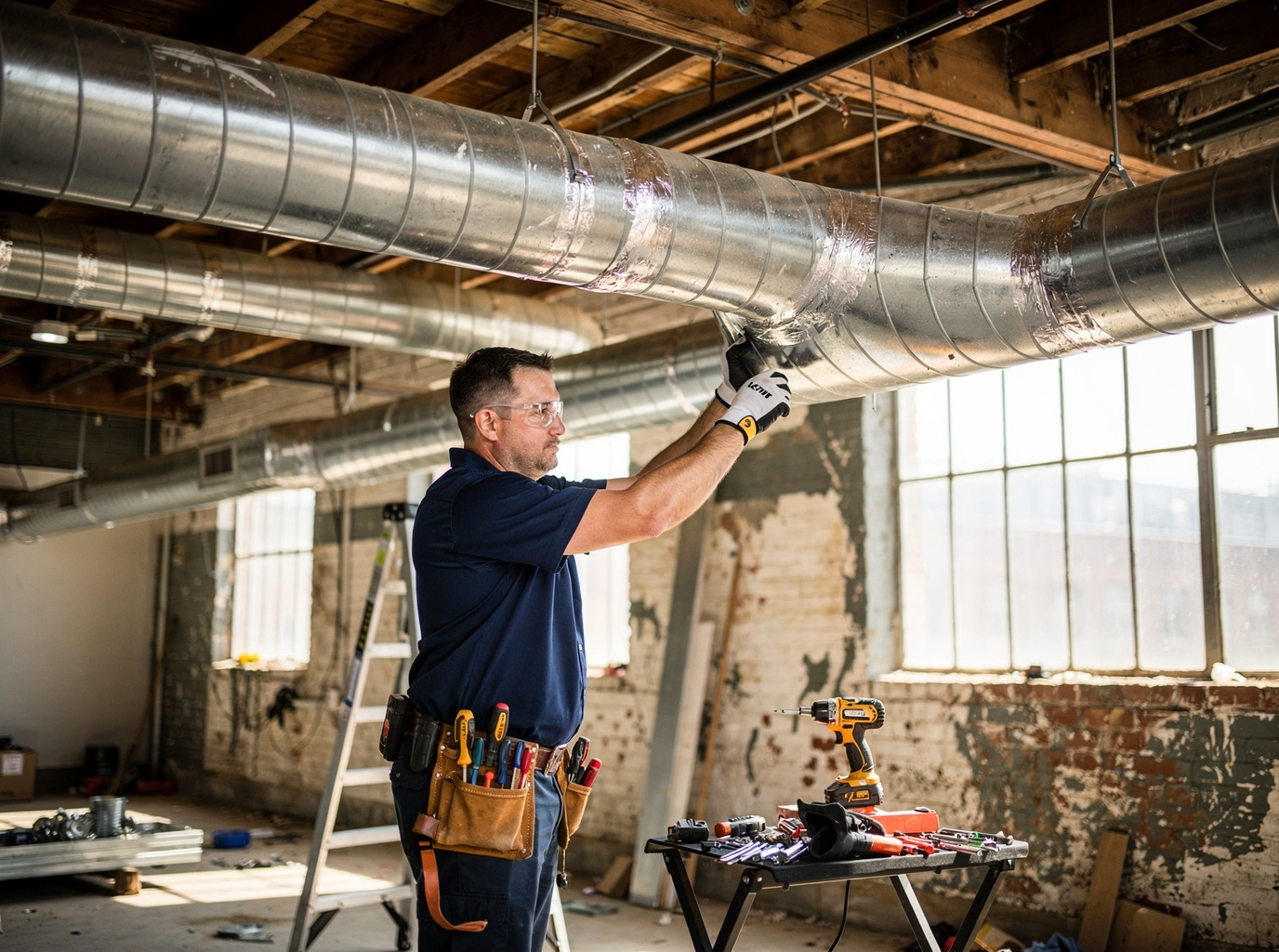
Philadelphia row homes built before 1950 dominate South Philadelphia, Fishtown, and Kensington, with narrow joist bays and plaster ceilings that limit standard duct runs. Installers often route flexible or rigid metal ducts through existing chases or create new soffits while preserving original trim. In these tight layouts, improper sizing quickly creates hot and cold spots on upper floors during summer peaks above 90 degrees.
Local code requires sealed ducts tested to 4 percent leakage or less when tying into new or existing HVAC systems. We use mastic and UL-listed tape on every joint, then insulate to R-8 minimum in unconditioned attics common in West Philadelphia and Manayunk. Older brick construction in Northern Liberties also means accounting for settling that can shift connections over time.
Humid summers here promote condensation on uninsulated metal, so we wrap supply runs serving bedrooms in Center City apartments and University City homes. Cold winter nights below freezing demand proper return-air paths to keep furnaces from short-cycling in Mount Airy and Roxborough colonials. Each job starts with a room-by-room load calculation rather than rule-of-thumb sizing.
Access through finished ceilings in Germantown twins often requires temporary protection and precise patching. We coordinate with homeowners to minimize dust in occupied spaces and complete most residential installs in one to two days when the layout allows straight runs from the mechanical room.
Technician insight
In Philadelphia, the thing that catches most people out with Ductwork Installation is the combination of 100-year-old plaster ceilings and summer humidity in South Philly row homes; one missed mastic joint or undersized return can create moisture problems that show up the first humid week after install.
South Philadelphia Row Home Retrofit
Homeowner in a 1920s South Philadelphia row home reported uneven cooling on the second floor. Inspection showed collapsed flex duct in the joist bay and unsealed joints leaking into the plaster ceiling. We replaced the run with rigid metal, added R-8 wrap, and sealed all connections. Second-floor temperatures equalized and humidity stayed below 55 percent through the next summer.
Ductwork Installation Services We Offer
✓Residential Duct Installation in Row Homes
Custom rigid and flexible duct routing through narrow Philadelphia row-home joist bays with minimal ceiling disruption.
✓Historic Building Ductwork Retrofit
Low-profile duct runs and soffit concealment for pre-war homes in Center City and Northern Liberties while meeting current energy codes.
✓New Construction Duct Installation
Full trunk-and-branch systems sized for new builds in University City and Fishtown using mastic-sealed joints and R-8 insulation.
✓Duct Sealing and Insulation Upgrade
Mastic sealing plus added insulation on existing runs to reduce energy loss in older South Philadelphia and Kensington homes.
✓Commercial Ductwork Installation
Sheet-metal systems for small retail and office spaces near Reading Terminal Market and along Benjamin Franklin Parkway.
Ductwork Installation Cost in Philadelphia, PA
| Service | Typical Range | What Affects It |
|---|---|---|
| Whole-home residential duct install | $2,800–$6,500 | Higher in pre-1920 brick row homes with limited access |
| Duct sealing and insulation only | $650–$1,400 | Depends on linear feet and attic conditions |
| Historic retrofit with soffits | $3,400–$7,200 | Includes custom millwork matching in Center City |
| Small commercial trunk system | $4,500–$9,000 | Varies by square footage and ceiling height |
Ranges are typical for Philadelphia, PA and confirmed with an exact written quote before any work starts.
How it works
- 1
On-Site Assessment
Measure every room, note joist directions, and check existing mechanical space in the Philadelphia home.
- 2
Load Calculation and Layout
Run Manual J calculations and design duct paths that fit the building's age and construction type.
- 3
Material Selection and Fabrication
Choose rigid metal or lined flexible duct based on access and noise concerns for the neighborhood.
- 4
Installation and Sealing
Run and support ducts, seal every joint with mastic, and insulate where required by code.
- 5
Testing and Handover
Perform leakage test, balance airflow, and walk the homeowner through the new system.
Pricing
Upfront quotes after inspection; price moves with access difficulty and home age in Philadelphia neighborhoods.