
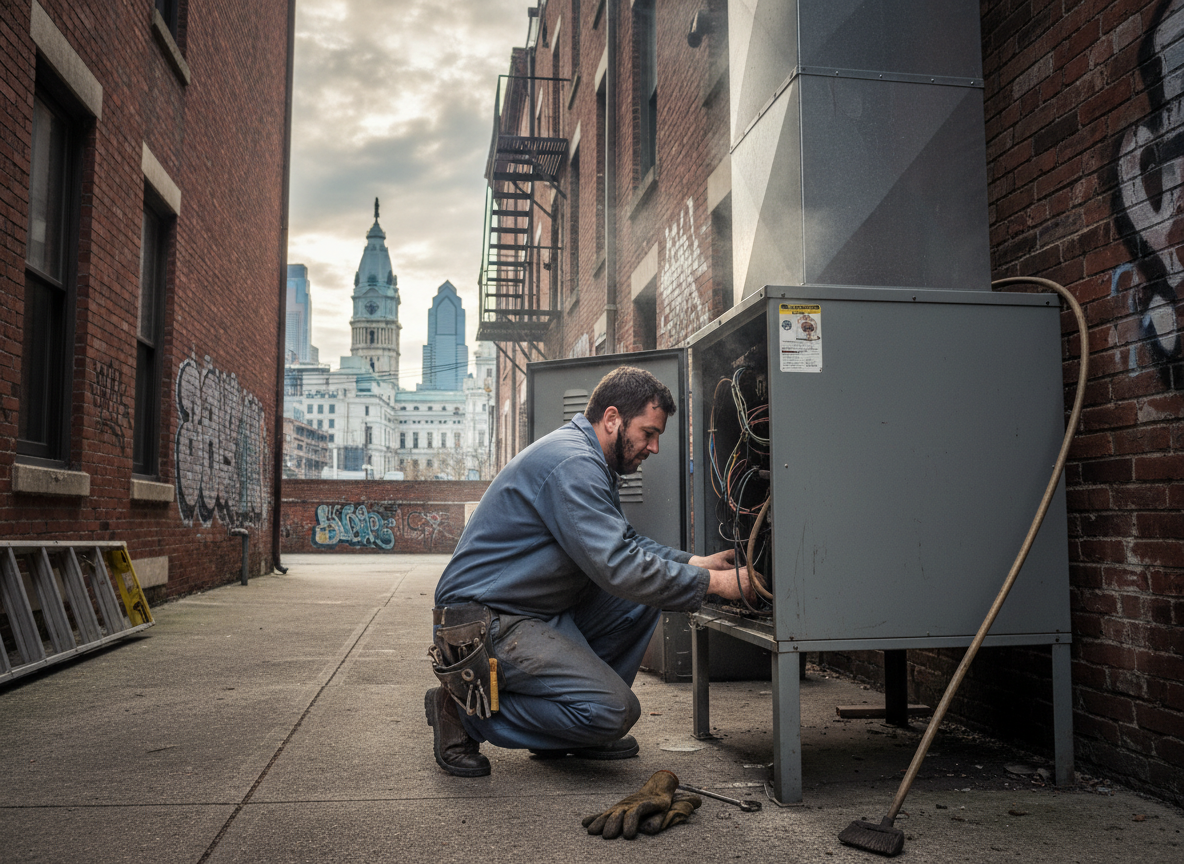
Philadelphia row homes built before 1950 in neighborhoods such as Kensington, Fishtown and Northern Liberties often have gravity furnaces or early forced-air units tucked into tight basements with limited access. Cold winter nights push these systems hard, and the humid subtropical climate brings rapid temperature swings that cause metal expansion and contraction around heat exchangers. Technicians at Green Air Heating & Cooling routinely find cracked exchangers or rusted flue pipes that must be addressed before carbon monoxide can enter living spaces.
In South Philadelphia and West Philadelphia, many homes still use original duct runs that have settled unevenly over decades. When a furnace cycles on during a January cold snap, restricted airflow from collapsed or disconnected ducts forces the blower motor to work harder and shortens its life. Proper repair includes checking static pressure at multiple points along the run rather than simply swapping the motor.
University City and Manayunk properties sit on sloped lots where basement moisture migrates toward furnace cabinets during heavy rains. Corrosion on gas valves and control boards appears earlier here than in drier suburbs. Every service call includes a moisture check around the unit and recommendations for proper condensate drainage to prevent repeat failures.
Technician insight
In Philadelphia row homes the thing that catches most people out with furnace repair is how quickly basement moisture from winter rains corrodes the gas valve on units sitting on dirt floors in South Philadelphia and Kensington; we see valves fail within two seasons if the cabinet stays damp.
Fishtown row home no-heat call
Homeowner in a 1920s Fishtown row home reported the furnace shutting down after 20 minutes. Inspection showed a cracked heat exchanger and restricted return air from settled ductwork. The exchanger was replaced and the main return trunk was resealed at the joints; the system now runs full cycles without tripping the limit switch.
Furnace Repair Services We Offer
✓Pilot Light Repair
Restores reliable ignition on older standing-pilot furnaces common in Kensington and Germantown row homes while checking thermocouple and gas pressure.
✓Blower Motor Replacement
Replaces failing motors in systems strained by Philadelphia winters and restricted ductwork, restoring even airflow through long runs in South Philadelphia homes.
✓Heat Exchanger Inspection
Uses visual and combustion analysis to locate cracks before carbon monoxide risks develop in older North Philadelphia and Roxborough furnaces.
✓Ignition System Diagnostics
Troubleshoots hot-surface igniters and flame sensors that fail during rapid temperature drops typical of Philadelphia winters.
✓Thermostat Calibration
Adjusts or replaces thermostats so furnaces cycle correctly in multi-story homes across Center City and University City where temperature differentials are common.
✓Flue Pipe and Vent Cleaning
Removes soot and debris from venting systems that serve high-efficiency units in humid Philadelphia basements to maintain safe exhaust flow.
Furnace Repair Cost in Philadelphia, PA
| Service | Typical Range | What Affects It |
|---|---|---|
| Pilot light and thermocouple service | $175–$325 | Higher when gas valve must be replaced |
| Blower motor replacement | $450–$850 | Depends on motor size and access in older basements |
| Heat exchanger inspection with combustion test | $150–$250 | Required before any major repair on pre-1990 units |
| Igniter and flame sensor replacement | $225–$400 | Common on 80% and 90%+ furnaces after 8–12 winters |
Ranges are typical for Philadelphia, PA and confirmed with an exact written quote before any work starts.
How it works
- 1
Phone Intake and Scheduling
Gather model, age, and symptoms, then book a same-day or next-day slot from the 1203 N 3rd St location.
- 2
On-Site Safety and Performance Check
Measure gas pressure, CO levels, and airflow before any disassembly in the home's actual basement conditions.
- 3
Targeted Repair or Part Replacement
Complete the diagnosed repair using OEM or equivalent parts matched to the existing system.
- 4
Post-Repair Testing and Homeowner Walkthrough
Run the furnace through cycles, verify safe operation, and explain any ongoing maintenance needs.
Pricing
Upfront quotes provided after inspection; typical furnace repairs range from minor adjustments to full component replacement.